
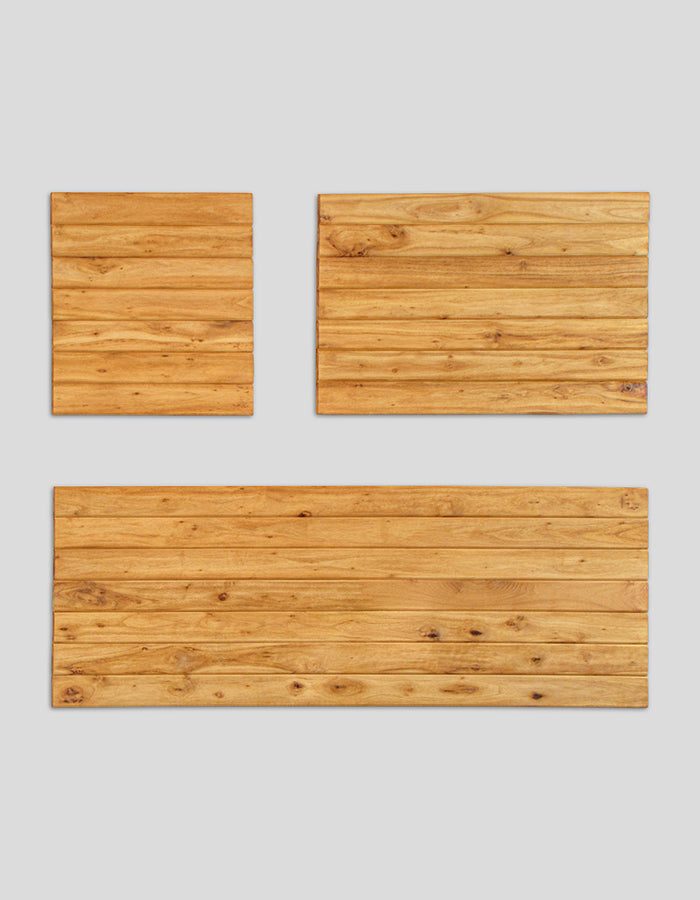

Facade boards tongue and groove, planed from robinia wood
SKU08.06.02.-0001
Delivery time: 14-28 business days
Availability for pickups could not be loaded
Product description:
The specified width is the surface width (measured without the tongue). The boards are planed to size from selected wood.
The specified width is the so-called surface measurement, measured from edge to edge, without the tongue.
The tongue is 7 mm wide.
The wood contains only knots that are well-grown. Planing creates a flat surface on the boards. However, minor roughness at grown-in knots or other areas with differing wood structure cannot always be avoided.
Boards made of black locust cannot be nailed - the wood is far too hard for that. If you manage to drive in a nail, the wood may split because it does not give in. Even when using wood screws, you must pre-drill. Stainless steel screws are recommended. Only galvanized screws will start to rust outdoors sooner or later, while black locust wood will last for decades.
By choosing black locust wood, you are opting for a wonderful product of nature. This is not an artificial, standardized material. Each piece has its individuality, its liveliness through certain irregularities. These only become defects if they impair functionality.
Dimensional tolerances: The specified thickness measurements apply with a tolerance of 0.3 mm (at the time of delivery). Due to drying, the thickness measurements can decrease by up to 6%. The specified length is accurate to within 2 mm.
Quality features: Even, straight-grown wood; at most small, grown-in knots in low numbers.
Warping and cracks: Wood is alive, as its moisture content - depending on the ambient humidity and climate - affects the dimensions and internal stresses of the wood. Across the grain (radial, tangential), the dimensions can change by up to 6% in practice, while along the grain (axial) the change is very slight.
Larger internal stresses are released by the wood warping and cracking. This must be taken into account. (Our ancestors, whose main material was wood, did this; we tend to forget it today.)
The above is even more true the harder the wood is; black locust wood is the hardest among woods.
How the wood warps and cracks is not concretely predictable. The drier the wood is, the greater the volume shrinkage and the more and larger the cracks are generally. There can be several cracks, or it can concentrate on just one large crack.
On the other hand, the thickness of the wood is crucial. The thicker the wood is, the greater the volume shrinkage that is "compensated" by the cracks. From thicknesses of 6 cm, cracks are unavoidable, no matter how carefully it is dried.
The ambient climate can vary greatly. Unprotected or covered outdoor areas, unheated or heated indoor areas, sunny side or shady side.
Since we do not know the ambient climate at the place of use, we deliver sawn timber air-dried, i.e., with a wood moisture content of about 20%, no more. Then there will be at most minor cracks - in relation to the thickness (see above). In a shady place, the wood will hardly dry out further.
Rapid further drying of the wood in the sun or in a protected place amplifies the stresses in the wood. Then the wood can warp and crack far beyond the unavoidable extent. If you store the wood, please do so in a shady, cool place and secured.
Cracks do not impair the strength, load-bearing capacity, and lifespan of the wood.

Recently viewed